

Russian wheat exports set for record year; SovEcon lifts 2025-26 outlook
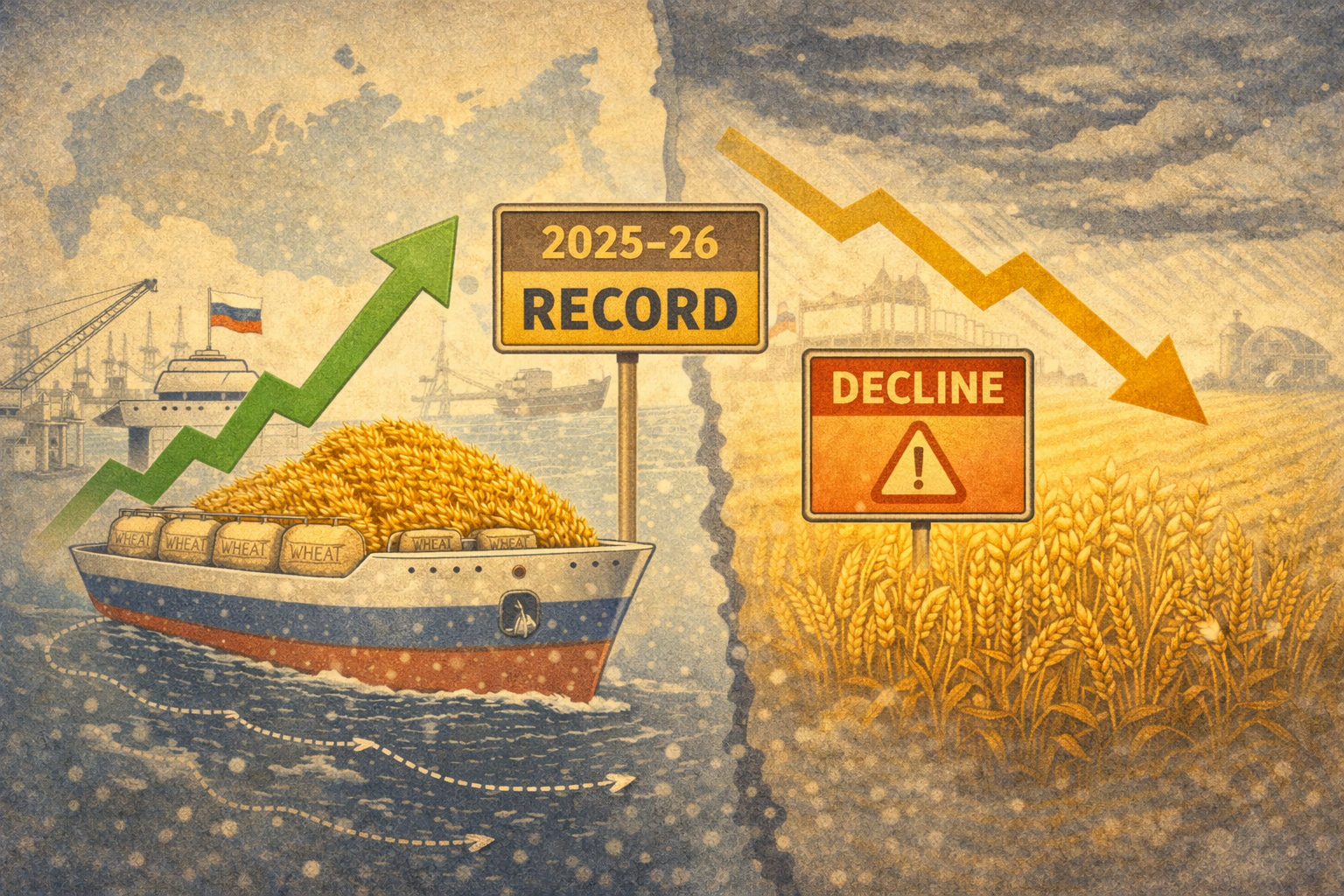
SovEcon, a prominent agricultural consultancy, has substantially increased its forecast for Russian wheat exports for the 2025-26 marketing season.
The projection has been raised by a significant 1.1 million metric tons (mmt), bringing the total expected exports to 45.7 mmt.
This revised figure represents a notable acceleration in Russia’s position as a major global wheat supplier.
The new forecast of 45.7 mmt is considerably higher than the 40.8 mmt exported in the preceding 2024-25 season.
Furthermore, it comfortably surpasses the five-year average export volume of 42.2 mmt, underscoring a potential shift toward a consistently higher export baseline.
Record-setting outlook
The decision to revise the forecast upwards is primarily driven by two key factors observed in the market.
Firstly, there has been a demonstration of remarkably strong export activity over recent months, indicating robust demand and efficient logistical operations.
Secondly, the revision is supported by relatively high official crop figures released by government agencies, suggesting a larger-than-anticipated harvest and ample supply for the export market.
This combination of strong market performance and favourable official supply data has prompted SovEcon to adjust its outlook to reflect this heightened export potential for the 2025-26 season.
Recent export surge and global drivers
Russian wheat exports have surged dramatically in recent months, setting notable benchmarks.
December saw a sharp increase in shipments, totalling 4.2 mmt, which marks the highest volume for that month in the last eight years, according to the consultancy.
This followed an even more impressive performance in November, when Russian wheat shipments reached a record-breaking 5.2 mmt for the month.
This substantial rise in export volumes underscores Russia’s dominant and growing position in the global wheat market, likely driven by a large domestic harvest and competitive pricing, impacting international commodity flows and prices.
Strong demand from major importers is expected to keep shipments relatively high in the coming months.
Recent purchases include Egypt’s Mostakbal Misr buying 0.7 mmt of wheat in late December, with a significant portion likely to come from Russia.
Additionally, Saudi Arabia’s GFSA made its largest purchase since February 2024, acquiring 0.9 mmt in mid-January, which included grain sourced from the Black Sea region.
The forecast for Russian wheat exports was revised upward, due in part to a relatively high supply.
Preliminary data from Rosstat, released in December, put the 2025 wheat harvest at 91.4 mmt, exceeding most market estimates, which ranged from 88.0 to 89.0 mmt, SovEcon said.
Anticipating a decline
For comparison, SovEcon’s December estimate for 2025 wheat production was 88.8 mmt.
“A 20 mmt export quota for major grains will take effect in mid-February, but in our view it will not materially affect shipments,” the consultancy said.
Wheat exports during the quota period from mid-February through July are estimated at about 16 mmt.
For the 2026-27 season, the initial wheat export forecast is 39.6 mmt, marking a 6.1 mmt reduction from the current season’s estimate.
This expected decline in shipments is attributed to tighter supply, following a relatively small harvest. SovEcon projects the 2026 wheat production at 83.8 mmt.
The anticipated domestic consumption for the upcoming season is projected to stay the same, attributed to a stagnant, zero-growth rate in livestock.
“In the coming months, we expect some increase in export shipments. However, we do not anticipate a significant acceleration in exports, given that a large share of stocks is located far from export regions,” Andrey Sizov, managing director at SovEcon said.
Additional limiting factors include a strong ruble and stable export prices.
The post Russian wheat exports set for record year; SovEcon lifts 2025-26 outlook appeared first on Invezz