

Morning brief: Asian markets rise, US House votes to block Canada tariffs
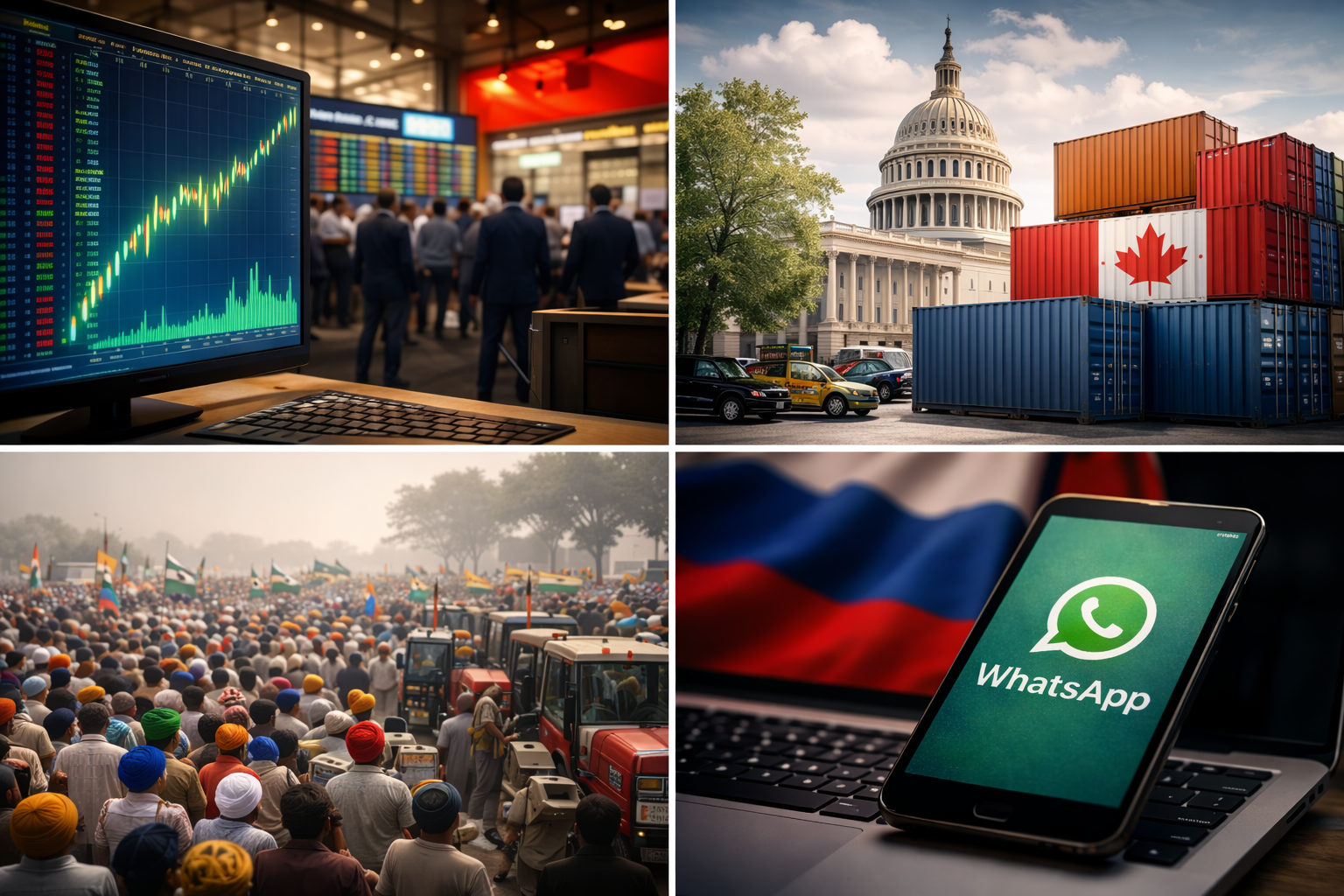
Global markets and geopolitics delivered a complex set of signals on Thursday, with equities climbing in Asia while policy disputes, trade tensions, and technology controls unfolded across major economies.
Investors tracked strong US labor data, a congressional rebuke of tariff policy, protests in India tied to a US trade agreement, and Russia’s move to block a major global messaging platform.
Asia equities rally as rate-cut expectations shift
Asian equities climbed to fresh highs after stronger-than-expected US jobs data reduced expectations for imminent interest-rate cuts.
Technology shares drove the rally, pushing benchmarks in Japan and South Korea to records and lifting MSCI’s broadest Asia-Pacific index 0.67%, leaving it about 13% higher for the year so far.
China’s CSI 300 was up 0.11%, India’s Nifty 50 was down 0.48%.
The labor data suggested tightening employment conditions, encouraging the Federal Reserve to keep policy steady in the near term.
Treasury yields rose, supporting the dollar, though analysts noted lingering uncertainty about policy direction.
The yen strengthened as investors reassessed policy expectations following Japan’s election outcome.
Meanwhile, oil prices gained amid geopolitical tensions, while gold eased after a prior surge.
US House lawmakers challenge Canada tariff policy
In Washington, the House of Representatives voted 219-211 to overturn tariffs imposed on Canada, with six Republicans joining Democrats.
The measure remains largely symbolic because the president could veto it, and it lacks a veto-proof majority.
House Speaker Mike Johnson acknowledged the difficulty of managing a slim majority, saying: “This is life with a small majority.”
President Donald Trump urged lawmakers not to oppose his policy, writing that any Republican who votes against tariffs “will seriously suffer the consequences come Election time, and that includes Primaries!” He added: “TARIFFS have given us Economic and National Security, and no Republican should be responsible for destroying this privilege.”
Democrats argued tariffs raised costs for households, while Republicans defended them as leverage in negotiations and security policy.
The dispute may ultimately be influenced by a forthcoming Supreme Court ruling on the president’s authority to impose tariffs.
Indian farmers protest over US trade deal
In India, thousands of farmers prepared nationwide demonstrations against a recently announced trade agreement with the United States.
Organizers fear increased agricultural imports could undermine domestic producers.
The protests recall the large-scale demonstrations of 2020-2021 that challenged the government’s economic agenda.
Authorities attempted to reassure growers. Commerce Minister Piyush Goyal said sensitive products such as dairy and poultry were excluded, and India made no concessions on genetically modified crop imports.
The agreement aims to reduce tariffs and expand US purchases, but changing language in official documents has added uncertainty.
The government faces the challenge of improving trade relations while protecting a politically important rural sector.
Russia moves to block Whatsapp
Technology tensions escalated as WhatsApp said Russia had moved to “fully block” its messaging service in an effort to promote a state-backed platform.
The company said it was working to keep more than 100 million users connected, though millions reportedly lost access.
The government has been promoting a domestic “super-app” called Max, which combines messaging with banking and government services.
Authorities are also moving to restrict Telegram, signaling a broader push to replace foreign communication platforms with national alternatives.
The post Morning brief: Asian markets rise, US House votes to block Canada tariffs appeared first on Invezz