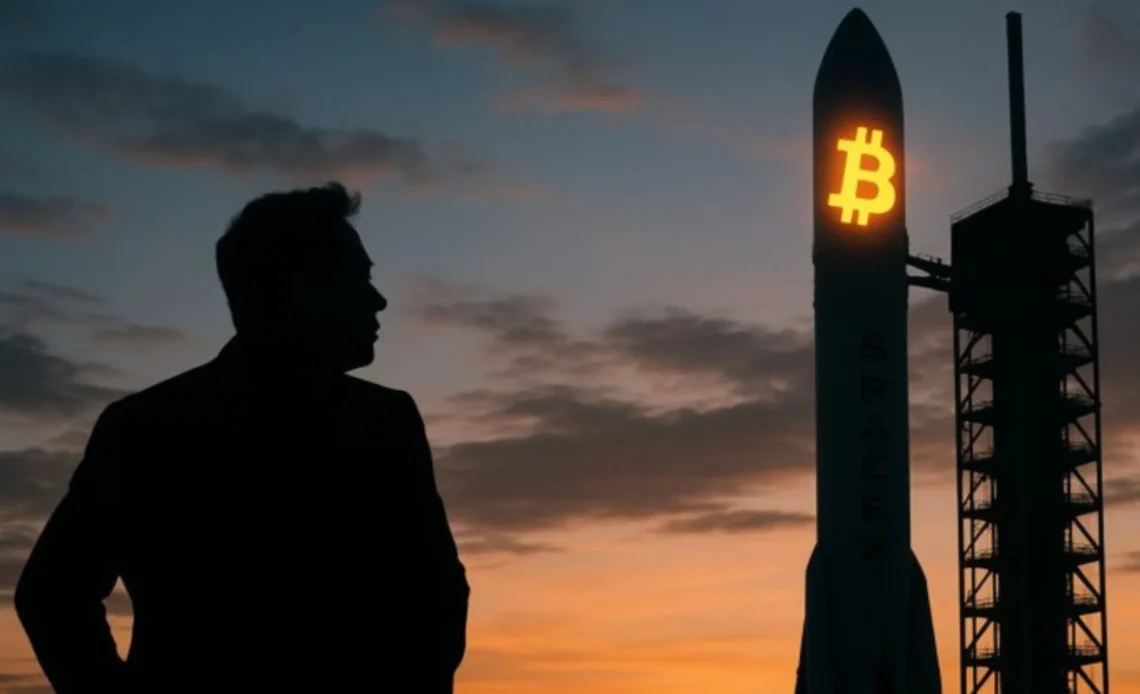
Space Exploration Technologies Corporation (SpaceX) officially submitted its Form S-1 registration statement to the United States Securities and Exchange Commission, formally confirming its intention to transition into a publicly traded entity under the Nasdaq ticker symbol SPCX. Tucked deep within the extensive regulatory prospectus, the Elon Musk-led corporation pulled back the curtain on its closely guarded balance sheet strategy, revealing a digital asset treasury that far outstrips previous third-party industry calculations.
Exceeding Outside Analytical Models to Surpass Tesla’s Sovereign Coin Balance
The foundational surprise within the SEC documentation centers on the sheer magnitude and execution details of SpaceX’s historical cryptocurrency accumulation program. The S-1 filing establishes that the Hawthorne, California-based enterprise holds exactly 18,712 Bitcoin, carrying an aggregate fair market value of approximately 1.3 billion dollars as of the close of the trailing fiscal quarter. This official balance sheet figure represents a massive, ten-thousand-coin divergence from previous blockchain intelligence data—such as public wallet tracking metrics from Arkham Research—which had erroneously estimated the private company’s maximum holdings at just over eight thousand tokens.
The regulatory disclosure permanently alters the hierarchy of corporate digital asset treasuries, positioning SpaceX as a significantly larger cryptographic accumulator than its publicly traded sister enterprise, Tesla Incorporated. Corporate treasury ledgers confirm that Tesla maintains an active balance of 11,509 Bitcoin, meaning SpaceX enters the public arena carrying a digital asset reserve that is roughly sixty percent larger than the automotive pioneer’s stack. According to supplementary historical data embedded within the prospectus, SpaceX initiated its structural token acquisition strategy in early 2021—precisely mirroring the timeline of Tesla’s initial 1.5 billion dollar capital deployment—acquiring the underlying asset block at an aggregate historical cost basis of 661 million dollars, which translates to a highly disciplined average entry price of approximately 35,000 dollars per coin.
Linking Cryptographic Reserves with Orbital AI Data Centers and Global Satellite Mesh Networks
Beyond basic treasury accounting, the Form S-1 provides institutional allocators with a highly advanced operational justification for embedding alternative digital property into a macro space exploration business model. The registration statement explicitly connects SpaceX’s massive Bitcoin reserves to its multi-generational expansion plans for the Starlink satellite internet constellation and its newly integrated artificial intelligence divisions. The company’s strategic roadmap outlines a highly aspirational regulatory application to deploy a network of space-bound orbital data centers, powered continuously by solar energy fields, designed to process compute pipelines entirely outside traditional terrestrial jurisdictions.
Within this futuristic decentralized industrial architecture, the company frames its digital asset treasury as a borderless, friction-free settlement layer engineered to handle automated machine-to-machine payments. As Starlink aims to capture what executive leadership labels the largest total addressable market in human history—valued at an estimated 28.5 trillion dollars across global connectivity, space transport, and automated AI infrastructure—the continuous presence of a liquid, sovereign digital reserve asset provides the company with an independent financial buffer to secure its massive capital expenditure pipelines. By utilizing the asset as a core balance sheet anchor alongside a robust cash reserve of 15.8 billion dollars, SpaceX constructs a highly resilient financial framework designed to absorb the intense, front-loaded development costs required to deploy thousands of next-generation low-Earth-orbit satellites.